Christian Svendsen The body in Egyptian and Hellenistic Hermetic thought
Christian Svendsen, The body in Egyptian and Hellenistic Hermetic thought. The Hellenistic Hermetic writings claim to be of Egyptian origin. The writer tries to test this claim, by describing the Egyptian and the Hermetic thoughts about the structure of man. Though there are a lot of obvious similarities in terminology, and similarities between concepts like the ba and the soul, and the kas and the powers of God, the basic understandings of life and body are very distinct. In ancient Egypt physical life was regarded as part of the good order, Maat, and had to be protected from forces of chaos, both in this life and in the next. In the Hermetic writings the forces of chaos reign in the physical world, the physical world therefore is a battleground between the creative forces of God and light, manifesting in the Hermetic culturehero, and the ignorant society and men totally identified with the physical body.
Various testimonies in the works of Hellenistic writers like Jamblichus, Manetho and Clemens of Alexandria point out that the Hellenistic world knew that all the wisdom of the profound wise Egyptians once had been contained in books of Thoth, the ibis-headed God of scribes, wisdom and the moon. This Thoth became through translation into Hellenistic Greek the Egyptian Hermes, or the threefold big Hermes (Hermes Trismegistos). Collections of texts, that were reputedly translations of part of this literature, circulated from the third and fourth century a.d., like one collection reportedly made by a certain Bitys. Hermetic writings of both philosophical and technical character (about alchemy, astrology and magic) were later to influence Arab culture, and through that, Europe from the 12?th century.
Since the 18’th century the Hermetic writings have been read by classical scholars as a mixture of Gnostic and Aristotelian traditions with no inner coherence. Egyptologists, though fascinated, have mostly been kept away by their preoccupation with the “real” classical Egypt. An erudite Danish Egyptologist, Erik Iversen has, however, contributed with profound studies.
The structure of man in Egyptian sources:
All possible creation lies as germs in the eternal waters of Nun -the unknown beyond the known. From here all beings arise1.
Gods like Khnum from Esna or Khonsu from Karnak was said to make (ir) the sperm in mans bones, and tied (tjs/mr) this sperm to the egg in the body of the woman, inside which he formed (qm) the foetus. This creation was often depicted as the artisans make earthenware.
The sperm of man was the source of the bones, while the milk of woman was the source of the muscles, tissues and skin. Other gods took part in the creation, among them were Heket, the frog-headed consort of Khnum, and Meschenet, who participated in the forming of the childs ka (the concept of the “ka” will be explained further on). Meschenet was also connected to the birthplace of the child, because the apotropaic tiles upon which the birth took place were named after her, and here Thoth was said to write the fate of the child. Also Thermutis (in Egyptian Renenet), and Schai took part in fixing the child’s fate. Heket helped to ease the birth. All mothers were identified with the heaven goddess Nut, who every morning would give birth to the regenerated sun, and mothers were also protected by the hippopotamus-headed goddess Thoeris. Thermutis and Thoeris protect the feeding of the infant. Other divine principles, like the bas of Heliopolis, were also connected to the physical development of the infant.
We do not know exactly when the child was named, but the importance of the name must not be underestimated in a culture, where threats from the unknown was always lurking. The name was part and parcel of the nature of what it named. In the creation theory of Memphis, Ptah “thought in his heart, and expressed through his tongue”, in a manner, that we know from the Jewish creation myth. This power of the word was not exclusively the tool of the gods. In the widespread religious magic the spoken word had performative power. Names could protect their owner, because part of it was often the name of a God. Knowledge of the name of a God - and the sacred stories connected to it - could magically draw the force of the God into this world to help.
The shadow must also be mentioned briefly. In a country like Egypt it should not surprise that the shadow had importance. It was seen as a manifestation of man, and was like the body exposed for attacks and threats from powers of chaos.
The structure of man in medical sources:
The medical texts, especially the Papyrus Ebers, and the Papyrus Smith, have sections that describe the physiology of the human body. There has been great debate about the proper interpretation of these texts. I follow the latest edition of the medical papyri (Bardinet:1995).
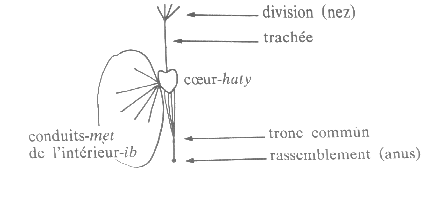
(Bartdinet:1995:118)
The centre of the human body is the haty, “that in front”, interpreted as the heart muscle. The heart receives the gods vitalising breath directly through the respiratory tract. (Gardiner:1982:91). The heart distributes this vitalising breath to the inner organs (the interior-ib) and the extremities, through channels called metw. The interior-ib and the haty-heart are the centers for life, rationality, feelings and individuality. Metaphors designating feelings are rooted in the heart, like happy (au ib - long ib), brave (mn ib - firm ib), trustworthy (ak ib - one who enters the heart) and joy (sndjm ib - sweet ib).
The metw channels have variously been interpreted as muscles, arteries, nerves and acupuncture meridians. Their function was to lead the vital breath, coolness, blood and water to organs and extremities, as well as being conduits for excrement’s. For health it was important that the metw did not stiffen, and excrement’s did not concentrate in them. One way to diagnose sickness was to palpate the metw, and thereby determine the condition of the heart.
Vital breath could also enter and leave the body through other body parts. The breath of life and death entered from respectively from the right and the left side through the ears and shoulders.(Ebers 854 f).
Sickness entered the body from the outside as bad breaths, demon-like powers always lurking near the body openings, especially the anus, or grew out of excrement’s or other kind of filth circulating in the metw. These pathogenic factors are called aaa, setet, ouhaou and oukhedou, and described both as snakes and swamps in the body.
The healer stood in a long tradition through a medical literature and famous godlike doctors, like third dynasty Imhotep. The diagnosis and treatment was a question of knowledge of the medical literary tradition. The doctor not only diagnosed and treated according to the above mentioned physiology, but entered the mythical and magical world. At least from the 18'th dynasty onwards, sickness was seen as Sethian or as underworld forces of chaos, trying to break the good rightful order, Maat. The doctor would reenact the victory of the Osiris, Isis and Horus over the chaos god Seth, or imitate the victory of Ra or Osiris over the nocturnal, underworld forces of chaos during their travel through the underworld, as it is described in the books about the journey through the underworld. Through performative utterances of magic the doctor could also become Isis, who protects the Horus child (the patient) from the attacks of Seth, the sickness. Or the doctor could become a participant in the trial, where Horus gained kingship from Seth. Or he could join the crew in the boat of the sungod Ra. Thereby the curing of the patient became equivalent to world survival. Or the doctor would threaten the gods: If they did not help the sick, the rituals at their temples will be abolished.
As the priest substitutes the king, when offerings are given to the dead, so sickness also ultimately was a consequence of the health of the king. His vital breath circulated in the country, as he is the haty-heart of Egypt. If his heart was not firm and his metw not healthy, the forces of chaos threatened the health of all individuals in Egypt.
The structure of man in funeral literature:
Death was understood as a rite of passage. If the right magical rituals were performed - the mumification and the opening of the mouth - the dead would live again in a multiplicity of bodies. If not, the dead would die a second death, and be utterly dead. Whether the multiplicity of bodies here to be described, also was a possibility for the living before death, cannot be determined as no mystical literature has come down to us.
So far I have described the name, the shadow and the physiology of man, emphasising the importance of the heart, and the inner organs. Now the possible post-mortem manifestations of man, the corpse, the ka, and the ba and the anch must be discussed.
The funeral rituals should secure that the body stayed vigorous (rwdj), firm (mn) stable and enduring (djd and wah) whole and sound (wdja) and not be destroyed (sbi, htm, ski). (Zabkar:1985:149). During the mummification process, and the ritual of the opening of the mouth, the dead was identified with Osiris, and the inner organs (interior ib) were divided in four groups, called the four sons of Horus.
The revitalising of the dead mirrored the mythical revitalising of Osiris by Isis. The chaos force Seth had captured, killed and cut up Osiris. Isis succeeded in finding all the parts of Osiris except his penis. A fish had eaten it already. By magic she created a new penis, put all his parts together, and got pregnant. In the semen of Osiris was a copy of his inner organs, and her first son, Horus, was therefore a copy of Osiris. Then she makes love with her son, Horus, and becomes pregnant with the four Horuschildren, e.g. the four organs in the human body: Amtef the liver (mst), Hapy the lungs (oufa), Duamutef the spleen (nenechem) or stomach, and Kebehsenuf the intestines (meshet). With these four sons or intestines Osiris can live again. The dead mans identification with Osiris was thus complemented with his organs being identified with the sons of Horus, together representing the revitalised life of the dead.
The organs were placed in the so called canope-jars. From different sources it can be seen that the four Horus-sons concentrate the whole universe in a “fourness”. Not only are they stars in the sacred Great Bear near the heavenly North Pole, but also the four directions, the potential life powers after death and the most powerful goddesses were connected to them2:
|
Name |
Amset |
Hapi |
Duamutef |
Kebehsenuf |
|
Goddess |
Isis |
Nephtys |
Neith |
Selket |
|
Organ |
liver |
lungs |
stomach/spleen |
intestines |
|
Canope-jar head |
human |
baboon |
jackal/falcon |
jackal/falcon |
|
Associated with |
ka |
heart |
ba |
sah/mummy |
|
Direction |
south |
north |
east |
west |
The ka has been understood as a human double, as a genius or the personified vitality. It was pictured as a clone of the “real” body, and created at the same time by a creator god, like Khnum. And often followed by a consort, a Hemswt. Gods and kings could have many kas and hemswts, ordinary man most often had only one ka and one hemswt.
The hieroglyphic sign for the “ka” is a pair of forward-stretched arms, and represents in a basic sense powers that also can be transmitted through embrace, like when the creator god Atum shared his kas with the first gods he created, among others Strength, Power, Prosperity, Honour, Light, Fame and Magic. For ordinary man the ka represented the materialised power of this man, and was thus a kind of destiny.
The importance of the haty-heart for the living has been described. It was of equal importance for the continued life of the dead. The heart, both viewed as the cardial muscle and as all the inner organs, was the crown witness, when the dead was put on a moral trial, before Osiris and other gods. The so called scarabees of the heart (scarabees because of homonymi between the name for “scarabee” and the verb “to become”) were often inscribed with chapters from the Book of the Dead, so magic would force the heart to protect its master during the trial - or rather force it not to betray him. The interior ib was weighed up against the feather of truth and order, Maat.
The ba has been interpreted, already in antiquity as a soul (yuch). From early times the bas were connected to the stars, and to the achs, a kind of demigods. They were in the heavenly context seen as manifestations of gods, Sirius was the ba of Osiris, Sothis was the ba of Isis, the sun was the ba of the sungod Ra. As Ra had fourteen kas he had seven bas.
For the individual the ba continued to live here in this world, eating, drinking and capable of unlimited capacity for movement. It was depicted as a bird with a human head, often seen drinking water in the cool shade of a sacred tree. It carried the offerings brought to the dead from the statue of the dead at groundlevel, down the burialshaft to the burialchamber with the mummy and the canope shrine. As the offerings often only consisted of the reading of the offeringformula (“a boon given by the king” - hotep-di-nesu) the ba was able to transform the performative magic words (hu and hike) into digestible vitality for the mummy. Connected with the strong Osirianism the survival of the ba relied more and more on the continual existence of the mummy. In the Book of the Dead, several chapters were preoccupied with this concern.
The sah was the mummy, that through the extensive rituals of mummification could secure eternal physical presence. The mummy and the statue above ground, both representing the deceased, were both taken through the ritual of opening the mouth, that made the new existence possible for the deceased. The opening of the mouth was performed with statues of gods in the temples, in order to make the god inhabit the statue, and be able to hear words and receive offerings. This was achieved through a complicated ritual with anointing, performative utterances and manipulating with obscure instruments, as can be seen for instance in the tomb of Sethos I. This ritual was without major changes performed on the dead at the funeral, in order that the deceased should regain all the faculties of sense and force he used to have.
If the rituals was performed with succes, the dead had gained a new physical and multiple existence as mummy, ba, ka, and an achu, a demigod residing in the stars.
The structure of man in the Hermetic writings:
The individual anthropogony (note 2) is described with Aristotelean terminology, of the four elements and their qualities. The womb is seen as a totally passive receptive for the sperm. The attractions and repulsions of the four elements give rise to breath (pneuma), and a divine form, whose prototype is situated in the heavenly zodiak, is being drawn into the process. At birth a moving principle also originating in the zodiak, the soul (yuch), is forced, very reluctantly to enter the body. The eternal form in the fixed stars can however only stay eternally on earth through the sexual meeting of male and female, because everything on earth is subject to change, growth and decay governed by the astrological powers of the heavens.
This understanding of human life is mirrored in the creation-myths, where a heavenly principle is attracted to an earthly body, and suddenly find itself caged in matter. The nous, or spirit, is inside the holy word, logos, logos is inside the soul, the soul is in the breath, and the breath pass through the veins, and arteries and blood (dia twn flebwn kai arthriwn kai aimatoV) and moves the living being, and carry it in a way.
The spirit (nouV or sensus divinitas) is the creative light issuing from the indescribable first principle, God. In man it can show itself positively as a sign of truth and negatively as a fire-demon, who punishes the evil human beings.
The logos has three manifestations: 1/ The word of God manifests through the light of the spirit, and is holy and creative. 2/The holy word, that manifests in hymns and teachings of holy men and in the Egyptian language itself, and 3/ the profane use of language among ordinary people.
The soul moves matter. As there are many kinds of matter, there are many kinds of souls, though they all basically are made of the same material. They are, according to their pureness and transparency, arranged in a highly hierarchical system, that for men mirror the social system: Kings, astrologers, musicians and philosophers have the most noble souls, dolphins have the most noble souls among the animals in the sea, the eagle among the birds and the lion among the quadrupedes. The souls can reincarnate in any being that moves, though one text claim, that once a soul has entered a human body, it cannot enter an animals body again (note 3).
Breath is partly the manifestation of the movements of the soul, moving and carrying the body, partly the nature of matter.
Most of the parts of man are describable with the Aristotelian elements. Spirit is light and a such the purest manifestation of fire, the souls and their breath are a mixture of fire, air and holy words and the body is made of the elements water and earth. The microcosm of the body is thus, as macrocosm, held in an asymmetrical order: The active heavenly elements shape and dominate the passive elements of matter.
In the Hermetic writings the asymmetrical order has been broken, and the earthly elements has freed themselves from the dominion of the heavenly elements. This has happened partly through ignorance among men, and partly because Egyptian culture is threatened by foreigners. Most of the teachings in the Hermetic writings are teachings, meant to re-establish the original asymmetrical order.
Those who undertake this task are the pupils of the teacher Hermes. These pupils I see as Hermetic culture heroes. They do their work in two dimensions, a vertical and a horizontal. The vertical dimension deals with meditative practices of totally leaving the identification with matter and thereby make a fusion with the creative forces possible. The horizontal dimension deals with social practices.
The vertical practical dimension is a consequence of listening to, visualising and thinking about the teachings (note 4). In order to drop any identification with matter, a number of meditative techniques are used: 1/ Meditative silence 2/ The heavenly journey of the soul, in order to transcend all creation and astrological restrain, and enter into the indescribable realm of God. 3/ The worship of the celestial order, that convinces the pupil of a higher reality 4/ The direct transference of experience of the sacred through listening to and recitation of sacred hymns - heard by the teacher on his heaven-journey, when he visited the souls in the fix stars (note 5), and 5/ An embrace of the teacher, as an initiation. Having experienced the creative forces of God, and melted with them, the culture hero can start working in the horizontal dimension: He must create and stay pure: The creativity shows itself through: 1/ Teaching of the ignorant. 2/ Studying the celestial laws, and by astrology or by other means foretell the future. 3/ Create works of art, and develop the sciences (note 6). 4/ Enjoy sexuality, and thereby materialise the creative force itself (note 7). The state of purity is upheld by: 1/ Withdrawing from ordinary society. 2/ Follow teaching sessions with more experienced teachers. 3/ Participating in ritual hymn singing, when the sun rises and sets 4/Keep up a vegetarian diet.
A comparison between the body in Egyptian thought and Hellenistic Hermetic sources - continuity or not?
The Hermetic writings claim to be a revival of ancient Egyptian wisdom and lore. In order to judge this claim I have described the Egyptian and the Hermetic ideas about the body and other parts of the human being. Here I will compare these two traditions:
Ancient Egypt was a homogenous culture. The wisdom of scribes and priests kept up a hierarchical society with the God-incarnated king in the middle. This order was described as rightful and good order, Maat. This society mirror itself in the body, with the haty-heart that receive and distribute the holy breath of the Gods to the specialised organs and the undifferentiated extremities. The dangers that threaten the Egyptian society and the Egyptian body are powers of chaos. These forces are kept away by the cleaning forces in magic, rituals and therapeutic means like fasting, massage, anointment and washing. Death is seen as a rite of passage, where Maat can be re-established in a new multiple existence. Physical life is not something to be transcended, but has to be enjoyed fully before and after “the first death”.
The Hermetic writings present a threatened culture. The Egyptian culture and wisdom is threatened by foreigners, by the unholy Greek language, and by a society that uncritically worships matter and the body. Order has to be re-established, and this can be done by following the culture hero-tradition from an original Hermes, through Isis and Osiris to the new teacher Hermes. The good society is hierarchical with kings, astrologers, musicians and philosophers on top. The body mirror society: The physical body is made of water and earth, and have no reality of its own. The soul, the word and the spirit are closer to the creative forces of God, and they mould and move the physical body. Man must therefore drop any identification with matter, and identify, and purify his spiritual aspects. Part of this spiritual quest is to continue the demiourgical work, that originally was Gods intention with the souls. Man must cultivate the earth by crafts, science and art, and enjoy sexuality, because these actions mirror the creative forces of God. Man has a more spiritual nature than woman.
The differences are clear: In ancient Egypt there were no idea of building blocks, like the Aristotelian elements and their qualities in the Hermetic writings. The established order in Egypt, Maat, in body and society was ultimately determined by the Gods and the king. Physical life was good, and there was no body/mind-split. Life after death was seen a possibility for continued physical enjoyment and pleasure. In the Hermetic writings life on earth was evil, if it was not shaped by the creative forces of God. Man could choose to identify with these creative forces, the soul and the spirit, and help God in the continued cultivation of earth. The astrological determined fate shaped life for the individual in the Hermetic writings machine-like, while fate in ancient Egypt determined by mythic gods, though heavenly influences were important.
The similarities are also clear: The names, especially in the Stobaiosfragments F23-26, like Kamephis, Kneph and Osiris/Isis leave no doubt of Egyptian origin. Also astrological terminology like the decans is of Egyptian origin. The description of the unlimited capacity for movement, and the home in the stars seem combine the ba and the soul. The direct transference of knowledge through an embrace recalls Atum's transference of ka-power to other Gods, therefore a continuity of the ka-concept could be seen here. The gods and the creative forces of God in the Hermetic writings, like Wisdom (Sofia), Eternity (Aiwn), Necessity (Anagkh), the lightword (nouV) and Fate (Eimarmenh) mirror the kas of the sungod Ra. The individual spirit may mirror the individual ka. The creative power of the word is central both in Egyptian magic, that protects the body and society, and in the Hermetic writings. In the Hermetic writings this shows itself, not only through the creative power of teaching, but directly in the idea of the holy Egyptian language, and the use of sacred sounds, also to be found in the so-called magical papyri.
The Hermetic writings certainly contain traits of Egyptian origin, and may be a Hellenistic blend of old and new But the basic ideas of the human body, and of life quality generally, are very distinct. Basically the Egyptian view of the body was rooted in a protection of the order established by gods, through all available means. The Hermetic view was that order had to be re-established, through a cultivation of the earth and the body, that had sunken into chaos. This cultivation necessitated identification with the creative powers in man, spirit and soul, and the use of the sciences, arts and crafts.
Notes:
Note 2 F3, F15
Note 3 Examples of reincarnation: CH2.17, CH10.7-8, CH10.21, A12, A28, F23.39, F23.42.In CH10.19 it is denied that the soul of a man ever can re-enter the body of an animal.
Note 4 The verbs akousai, qeasqai, nohsai and gnwnai seems in CH1 and CH11 to describe stages in the teaching.
Note 5 CH 1.25-26, NHC 58.18, CH 13.15, F 23.14 - 24, Hymns: CH 1.31, CH 13.17-20, A 41, NHC 61.5-17
Note 6 A 6, A 8, A 10, CH 3.3-4
Note 7 A 21, CH 1.18, CH 2.17
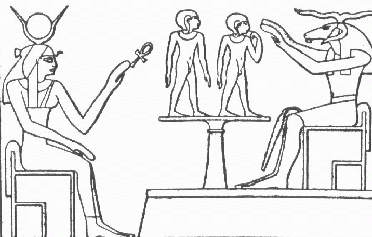
The ka is formed as earthenware by the God Khnum, Bonnet, p.358
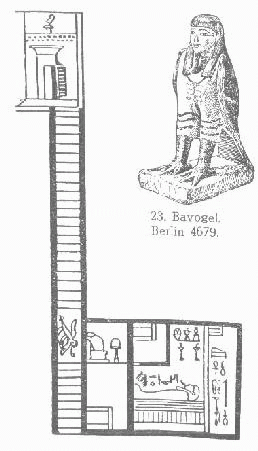
The ba-bird and the ba bringing food and drink to the mummy, Bonnet, p. 76
Sources:
CH = Corpus Hermeticum, see Nock & Festugiere
A =Asclepius, see Nock & Festugiere
F = Stobaios Fragmenta, see Nock & Festugiere
NHC= Nag Hammadi Codex VI, see Mahe
Ebers = Se Grapow
Ambrose, Elizabeth Ann, Sixteenth Century Philosophy 30, Bibliography to the Hermetic writings, St.Louis 1992
Bardinet, Thierry Les papyrus medicaux de l’ Egypte pharaonique, Fayard, 1995
Bonnet, Hans Reallexikon der Agyptischen Religionsgeschichte, Berlin, 1952
Dumichen, Resultate der 1868 nach Agyten entsendeten archaologisch-photographische Expedition, Berlin, 1869
Faulkner, R.O. The Ancient Egyptian Book of the Dead, London, 1972
Fowden, Garth The Egyptian Hermes, Cambridge,1987
Gardiner, Alan Egyptian grammar, Oxford, 1982, (1.ed. 1927).
Grapow, H a.o. Grundriis der Medizin der Alten Agypter, Berlin, 1954-1973
Iversen, Erik Hermetic and Egyptian Tradition, Museum Tusculanum, 1982
Lepsius, Denkmaler aus Agypten und Athiopien, Berlin 1849- 1913
Mahe J.P. Hermes en haute Egypte, vol.I-II, Quebec, 1978
Nock A.D. & Festugiere A.J. Corpus Hermeticum, vol. I-IV, Les Belles Lettres, Paris, 1991, first ed. 1946-54
Horst, Pieter Willem van der Chaeremon, Leiden, E.J.Brill, 1984
Zabkar, L.V. A study of the ba concept in ancient Egyptian texts, Chicago, 1968

1 “Les theories medicales des Egyptiens apparaissent par la toujours parfaitemnet integrees a leur conception du monde. Meme les vieux mythes cosmogoniques sont a prendre en consideration. Ainsi la vision egyptienne du moment precedant la creation est celle d?un univers liquide, le Noun, ou se trouvaient en germe tous les elements constitutif du monde. L?idee de base semble la suivante: Tous les constituants du monde organise que l?Egyptien a sous les yeux, et qui lui paraissent lies, hierachises par une meme volonte divine batissant les etres vivants, se trouvaient a l?origine disperses dans une sorte de soupe primitive ou le corps meme du demiourge etait dissous. L?appartion du demiourge par une sedimentation naturelle et “qui passe d?un etat a un autre de lui-meme” (kheper djesef) disent les textes, fait que la creation, c?est-a-dire l?organisation des eleements disperses, peut commencer. Des lors, l?intervention directe du dieu dans les affaires du monde devient regle et ne cessera jamais. Le Noun, comme reservoir potentiel de germes de vie, continuera son existence,a la peripheri du monde deja bati. Le Nil prenant sa source dans cet inepuisable reservoir, chaque inondation amenera de nouvelles creations…L?intervention des dieux est donc une constante autour de l?homme et dans l?homme Toute recherche des causalites y ramene et toute speculation medicale officielle se deroule dans le cadre etroit des causalites divines”. (Bardinet:1995:62).
2 Zeitschrift fur agyptische Sprache und Altertumskunde, 1877, 30 Lefebvre, Annales du service des Antiquites de l?Egypte, 20, 277 Book of the Dead, Ch.17. R. Lepsius, Denkmaler aus Agypten und Athiopien, Berlin 1849- 1913, III (pp.137, 170). Pyramid Texts: 1092, 1338/39, 1828 ff, 2078. L.D. 163, Dumichen, Resultate der 1868 nach Agyten entsendeten archaologisch-photographische Expedition, Berlin, 1869, T.46.

You can contact me on: lingzhi999@hotmail.com